The VA loan appraisal requirements in Florida for 2026 mandate that a property must be safe, structurally sound, and sanitary, meeting both national VA Minimum Property Requirements (MPRs) and specific state standards for wind mitigation, wood-destroying organisms, and roof condition.
For Veterans and active-duty service members looking to buy a home on Florida’s Space Coast, understanding the VA appraisal process is a critical step toward a successful closing. Unlike a conventional loan appraisal that focuses solely on value, the VA appraisal adds a layer of protection for the Veteran, ensuring the home is a safe and sound investment. This isn’t a "wish list" inspection; it’s a fundamental check for livability.
At Morgan Financial, our team of veteran-owned, Melbourne-based experts specializes in guiding military families through this unique process. We know the Brevard County housing market—from Titusville to Palm Bay—and can help you anticipate and navigate the specific hurdles of a Florida VA appraisal, ensuring your journey to homeownership is smooth and successful.
Key Takeaways
- MPRs are Mandatory: Every home purchased with a VA loan in Florida must meet the VA’s national Minimum Property Requirements (MPRs) for safety, soundness, and sanitation.
- Florida-Specific Focus: Appraisers in Florida pay extra attention to roof condition (requiring 3-5 years of remaining life), wind mitigation features, and evidence of termites (WDO).
- WDO Inspection is Required: Florida is a mandatory state for a Wood-Destroying Organism (termite) inspection for all VA purchase loans.
- Appraisal vs. Inspection: A VA appraisal is not a substitute for a comprehensive home inspection. The appraisal protects the lender and Veteran from a bad investment, while an inspection details the home’s overall condition for the buyer.
- Local Expertise Matters: Navigating a low appraisal or required repairs is much easier with a local lender who understands the Space Coast market and has a network of trusted professionals.
Understanding VA Minimum Property Requirements (MPRs) in Florida
VA Minimum Property Requirements (MPRs) are a set of safety and structural standards that a home must meet in 2026 to qualify for a VA-backed mortgage. These standards are designed to ensure the property you’re buying with your hard-earned benefit is a secure, livable, and wise financial investment. The VA appraiser is not there to find fault with the home’s cosmetic features; they are working on behalf of the Veteran to verify the home meets a baseline standard of quality.
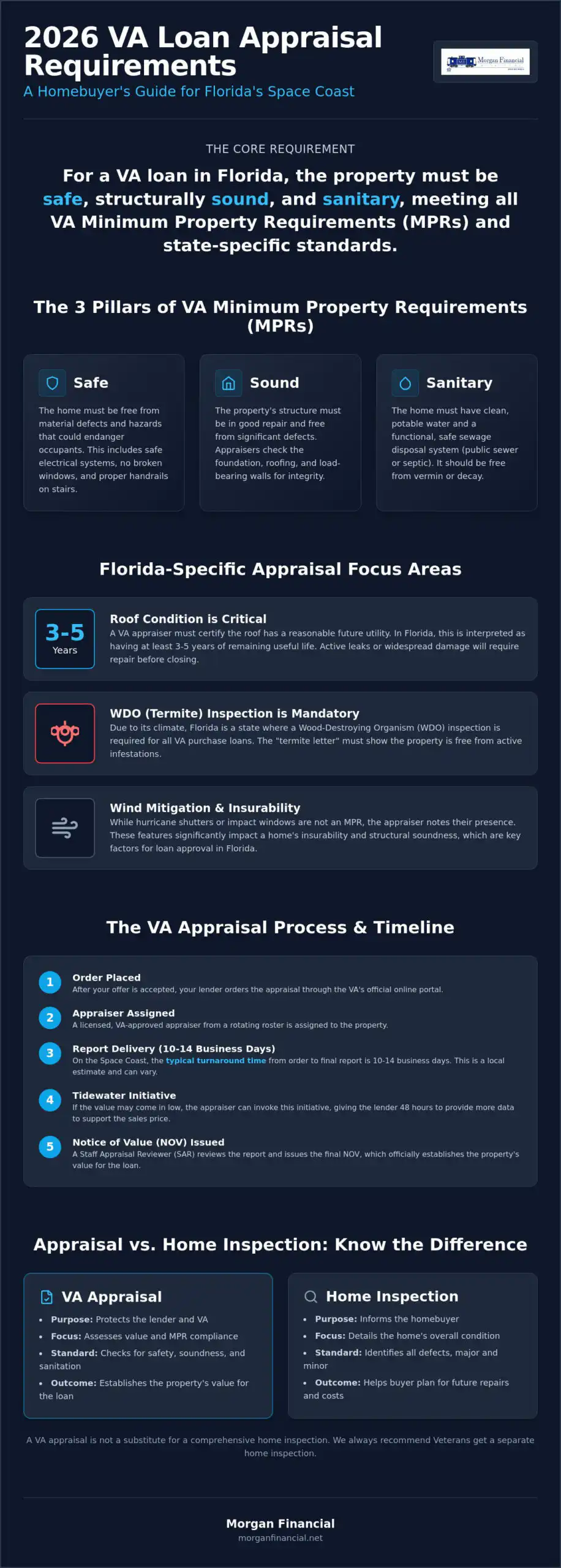
The core of the MPRs can be summarized by the "Three S’s":
- Safe: The home must be free from hazards that could endanger the occupants. This includes issues like exposed wiring, broken windows, or missing handrails on stairs.
- Sound: The structure must be intact and in good repair. The appraiser will look for significant defects in the foundation, roofing, and load-bearing walls that could compromise the home’s integrity.
- Sanitary: The property must have clean, potable water, a functional septic or sewer system, and be free from vermin or decay.
It’s crucial to remember that the VA appraiser’s goal is to protect you. By enforcing these MPRs, the VA helps ensure you aren’t buying a property that will require immediate, costly repairs just to be habitable. It’s a layer of protection built directly into your VA loan benefit.
Core Structural and Safety Standards
In Florida, VA appraisers evaluate several key systems to ensure they meet MPRs. The home must have a heating system capable of maintaining a temperature of at least 50 degrees Fahrenheit in areas with plumbing. While central air conditioning is not a strict VA requirement, an inoperable HVAC system in a Florida home will almost certainly be flagged, as it’s essential for comfort and controlling humidity.
The electrical system must be adequate for the home and free of hazards like frayed or exposed wiring. Outdated and potentially dangerous electrical panels, such as Federal Pacific or Zinsco panels, will require replacement. The property must also have a reliable water supply—whether from a city connection or a private well—that provides safe drinking water and a functioning septic or public sewer system.
Finally, the home must provide adequate living space for its occupants. The appraiser will also check for "encroachments," ensuring that the home’s structures or fences do not improperly cross over onto a neighboring property line, which could cause legal issues down the road.
The 2026 VA Appraisal Timeline
Once your offer is accepted on a home in Brevard County, your lender will order the VA appraisal through the VA’s online portal. A licensed, VA-approved appraiser is then assigned from a rotating roster. In the Melbourne-Palm Bay area, the typical turn-around time for a VA appraisal is 10 to 14 business days from the date of the order to the delivery of the final report.
If the appraiser determines the home’s value might come in lower than the sales price, they can invoke the Tidewater Initiative. This gives the lender 48 hours to provide additional comparable sales data to support the contract price before the final value is set. This is a powerful tool that can prevent a low appraisal from derailing a transaction. For a detailed explanation, read our guide on What is the VA Tidewater Initiative?
After the appraiser completes their report, it is reviewed by a Staff Appraisal Reviewer (SAR). The SAR is a representative of the lender who has the authority to review the appraisal, ensure it meets VA guidelines, and issue the final Notice of Value (NOV), which officially establishes the property’s value for the loan.
Florida-Specific Appraisal Factors: Roofs, Wind, and Water
In Florida, VA appraisers pay special attention to roof age, wind mitigation features, and evidence of wood-destroying organisms (WDO) common to the Space Coast. While national MPRs provide a baseline, our state’s unique climate of intense sun, hurricanes, and humidity creates specific areas of concern that must be addressed for a home to pass a VA appraisal.
The roof is a primary focus. A VA appraiser must certify that the roof is in good condition and has a reasonable future utility. In Florida, this is generally interpreted to mean the roof must have at least 3 to 5 years of remaining useful life. A roof with active leaks, significant granule loss, or widespread damage will need to be repaired or replaced before the loan can close.
Wind mitigation features, such as hurricane shutters or impact-resistant windows, are not a strict VA requirement. However, their presence is noted by the appraiser as it impacts the home’s insurability and overall soundness—two key factors for loan approval. Finally, due to our climate, the risk of termites and other wood-destroying pests is high, making a WDO inspection a non-negotiable part of the process.
The "Termite Letter" and WDO Inspections
Florida is one of the states where the VA mandates a Wood-Destroying Organism (WDO) inspection, often called a "termite inspection," for all VA purchase loans. This is because termites and other pests can cause significant structural damage that might not be visible during a standard appraisal.
A licensed pest control company must perform the inspection and provide a "termite letter" or report detailing their findings. According to updated VA rules for 2026, any party to the transaction—including the Veteran buyer—can pay for the WDO inspection. If the report finds evidence of an active infestation, it must be treated by a licensed professional. The report may also note "conducive conditions," such as wood debris touching the foundation, which will likely need to be corrected before closing.
Flood Zones and Drainage on the Space Coast
Given our proximity to the Atlantic Ocean and the Indian River Lagoon, many homes on the Space Coast are in designated flood zones. If a property is located in a FEMA-designated Special Flood Hazard Area (SFHA), the VA appraiser will note this, and you will be required to obtain flood insurance. The home must also have proper access from the street that is not impeded by floodwaters during typical storms.
Proper site drainage is another critical factor, especially for the concrete slab homes common in Melbourne and Viera. The appraiser will ensure the ground slopes away from the foundation, preventing water from pooling against the home, which can lead to moisture intrusion and foundation issues. For older homes with a crawl space, the appraiser will check for adequate ventilation and any signs of excessive moisture or standing water, which must be remedied.
VA Appraisal vs. Home Inspection: Knowing the Difference
A VA appraisal estimates market value and checks for basic MPRs, while a private home inspection provides a deep-dive into the mechanical and cosmetic health of the property. Many first-time homebuyers mistakenly believe the VA appraisal is a substitute for a home inspection, but they serve two distinct and equally important purposes. The appraisal protects the lender’s investment, while the inspection protects your personal investment.
Think of it this way: the VA appraiser is looking for "Safety" issues (deal-breakers for the loan), while a home inspector is looking for both safety and "Maintenance" issues (items that you, the buyer, need to be aware of for future budgeting). At Morgan Financial, we strongly recommend every Space Coast homebuyer invests in both to get a complete picture of the property they are purchasing.
| Factor | VA Appraisal | Private Home Inspection |
|---|---|---|
| Purpose | Determine market value and verify the home meets VA’s Minimum Property Requirements (MPRs). | Provide a detailed report on the overall condition of the home’s systems and structure. |
| Who Performs It | A VA-certified, state-licensed appraiser assigned by the VA. | A state-licensed home inspector hired directly by the buyer. |
| Who It Protects | The lender and the Veteran (from a bad investment). | Primarily the homebuyer (from unexpected repair costs). |
| Key Focus Areas | Safety, Soundness, and Sanitary conditions. Focuses on major, visible defects. | Functionality of all systems (HVAC, plumbing, electrical), appliances, roof, and structural components. |
Why an Appraisal is Not a Guarantee
It is essential to understand the limitations of a VA appraisal. The appraiser performs a visual walk-through of the property; they do not test every outlet, turn on every faucet, or climb into every corner of the attic. Their job is to spot obvious MPR violations, not to create an exhaustive list of every minor flaw.
In a competitive market like Melbourne’s, some buyers may use an "Appraisal-Gap" strategy, where they agree to pay the difference in cash if the home appraises for less than the purchase price. This can make an offer more attractive to a seller, but it requires careful financial planning. A powerful tool to strengthen your offer is a Stronger than a Pre-Approval, which shows sellers you are a serious, well-qualified buyer.
Common "Deal-Killer" Repairs in Florida
While every home is different, certain MPR issues appear frequently in Florida properties and can stop a VA loan in its tracks if not addressed. These include:
- Peeling Paint: In any home built before 1978, any instance of peeling or chipping paint (interior or exterior) must be scraped and repainted due to the potential for lead-based paint hazards.
- Exposed Wiring or Outdated Electrical Panels: Any uncovered junction boxes, frayed wires, or missing outlet covers are immediate safety hazards. As mentioned, known problematic panels like Federal Pacific or Zinsco will also be flagged for replacement.
- Inoperable HVAC System: A non-working heating and cooling system is a major red flag in Florida’s climate and will almost always be required to be repaired or replaced to meet MPRs.
These are just a few examples of potential red flags. For a more comprehensive look at potential issues, see our guide on what fails a VA appraisal.
How to Prepare Your Space Coast Home for a VA Appraisal
Preparing for a VA appraisal involves a 5-step checklist focused on accessibility, safety, and functional systems to ensure a "clean" report. Whether you are the seller or the buyer wanting to help the process, taking a few proactive steps can prevent delays and ensure the appraiser can do their job efficiently. A smooth appraisal process helps keep your closing on schedule.
- Ensure all utilities are on. The appraiser must be able to test the electrical, plumbing, and HVAC systems. Make sure the water, electricity, and gas (if applicable) are active.
- Provide clear access. The appraiser needs unobstructed access to all areas of the home, including the attic, any crawl spaces, the garage, and the electrical panel. Clear away boxes or clutter that might block entry.
- Fix minor safety hazards. Walk through the property and look for easy fixes. Replace burnt-out light bulbs, install missing handrails on stairways, cover exposed electrical outlets, and repair any broken window panes.
- Check the water heater. The water heater must be properly strapped (if required by local code) and have a temperature and pressure relief (TPR) valve with a discharge pipe that extends to within 6 inches of the floor or outside the home.
- Complete any unfinished work. Ensure any ongoing repairs or renovations are complete before the appraiser arrives. An unfinished project can result in the appraiser requiring a second visit, causing delays.
Exterior Prep: Curb Appeal and Safety
The appraiser’s evaluation begins the moment they pull up to the home. In communities like Titusville or Palm Bay, make sure the yard is free of debris and the lawn is mowed. Check for any wood-to-ground contact, such as firewood stacked against the house or siding touching the soil, as this is a major risk for termites. If the property has a swimming pool, ensure it meets Florida safety codes with a proper fence and self-latching gates.
Documentation to Provide the Appraiser
Helping the appraiser with information can support a more accurate valuation. If you have them, provide a list of recent major upgrades with dates and costs (e.g., new roof in 2022, new AC in 2023, impact windows in 2024). If any major additions or renovations have been done, having the permit records available is helpful. You can also provide a list of recent comparable home sales in the immediate neighborhood that you feel support the contract price.
Navigating Appraisal Hurdles with Morgan Financial
If a VA appraisal identifies repairs or a value gap, our team at Morgan Financial utilizes local expertise to find solutions that keep your closing on track. An appraisal issue doesn’t have to be the end of the deal. With a knowledgeable local lender on your side, you have options and a clear path forward.
The final appraisal report is delivered as a Notice of Value (NOV). We will review this document with you, explaining the appraiser’s valuation and detailing any required repairs. If repairs are needed, they must be completed and re-inspected before the loan can close. In some cases, a Repair Escrow may be possible, where funds are set aside at closing to complete the work afterward, though VA rules for this are strict.
If the appraisal value comes in low, we can help you file for a Reconsideration of Value (ROV). This is a formal process to challenge the appraisal by providing new, compelling sales data the appraiser may have missed. Our deep knowledge of the Space Coast market is a significant advantage in successfully navigating an ROV.
Contact Morgan Financial today to start your VA loan journey with a team that knows the Space Coast.
The Morgan Financial Advantage
Choosing a local, veteran-owned lender makes all the difference. We understand the importance of your VA benefits because we’ve used them ourselves. Our Melbourne office means we know the local real estate agents, appraisers, and market trends intimately. When you call us, you won’t get a national call center; you’ll speak directly with a local expert committed to your success.
Next Steps for Brevard County Veterans
Ready to move forward? Here are your next steps:
- Gather your documents. The first step is to get your Certificate of Eligibility (COE). If you need help, we can guide you through the process. Learn more in our 2026 Guide to the VA Loan COE in Florida.
- Explore your resources. Browse our comprehensive VA Loan Resources page for more in-depth guides and information.
- Estimate your payments. Use our free online Mortgage Calculators to get an idea of your potential monthly payments for a home in 2026.
Frequently Asked Questions (FAQs)
Do VA loans require a termite inspection in Florida?
Yes, for 2026, the VA requires a Wood-Destroying Organism (WDO) or "termite" inspection on all purchase loans in Florida. This is because Florida is a state with a high incidence of termite activity, and the inspection is a protective measure for the Veteran.
Can a house with an old roof pass a VA appraisal in Florida?
A house with an old roof can pass a VA appraisal in Florida, provided the appraiser determines it has at least 3 to 5 years of remaining useful life and is free of active leaks. If the roof is at the end of its life or shows significant damage, it will need to be repaired or replaced before the loan can close.
Who pays for the VA appraisal in 2026?
Typically, the Veteran homebuyer pays for the VA appraisal. The fee is paid directly to the VA-approved appraiser. According to va.gov, the 2026 appraisal fee schedule for a single-family home in Florida will be posted on their official site. The cost is regulated by the VA and can be paid upfront or sometimes rolled into closing costs.
What happens if the VA appraisal comes in lower than the purchase price?
If the VA appraisal comes in low, the Veteran has several options: you can renegotiate the price with the seller, pay the difference in cash (the "appraisal gap"), or challenge the valuation through a Reconsideration of Value (ROV). You can also walk away from the deal, as the VA Amendatory Clause allows you to cancel the contract without penalty.
How long is a VA appraisal valid in Florida?
A VA appraisal, or Notice of Value (NOV), is valid for six months (180 days) in Florida. This means you must close on the loan within that timeframe. If the closing is delayed beyond six months, a new appraisal or an appraisal update may be required.
Are hurricane shutters required for a VA loan in Florida?
No, hurricane shutters or impact windows are not a mandatory requirement for a VA loan in Florida. However, the appraiser will note the presence or absence of wind mitigation features, as this can significantly affect the home’s insurability, which is a requirement for getting a mortgage.
What are the most common VA appraisal deal-breakers in Brevard County?
In Brevard County, the most common deal-breakers are roofs with less than three years of life remaining, evidence of an active termite infestation, and un-repaired water damage from past storms or leaks. Outdated and hazardous electrical panels (like Federal Pacific) are also a frequent issue in older Space Coast homes.
Can I buy a fixer-upper with a VA loan in Melbourne?
It depends on the extent of the repairs needed. A standard VA loan is intended for homes that are move-in ready and meet MPRs. A home needing minor cosmetic updates can qualify, but a property requiring major structural repairs will not. For significant renovations, you may need to explore a VA Renovation Loan.
Morgan Financial is an independent mortgage lender and is not affiliated with the Department of Veterans Affairs or any government agency.
Disclaimer
This content is provided for informational purposes only and should not be construed as financial, legal, or lending advice. It is not a commitment to lend. Mortgage programs, rates, terms, and availability are subject to change without notice and may vary by borrower and location. All loans are subject to credit approval and applicable underwriting guidelines. Not all applicants will qualify. Consult with a licensed mortgage professional regarding your specific situation.