VA loan occupancy requirements mean the veteran, service member, or qualifying spouse must intend to live in the home as a primary residence, not buy it as a vacation home or investment property. VA says purchase borrowers must qualify for a Certificate of Eligibility, meet VA and lender standards for credit and income, and live in the home being purchased.
Key Takeaways
- VA purchase loan eligibility includes an occupancy requirement: the borrower must live in the home being bought with the VA-backed loan.
- VA Form 26-1820 has the veteran certify that they currently occupy the property, intend to occupy it within a reasonable period of time, or intend to reoccupy it after major repairs or improvements.
- If a veteran is on active duty and unable to occupy the home, VA regulations allow the active-duty veteran’s spouse to certify the intent to occupy the property as a home.
- VA purchase loans may be used for a single-family home, a VA-approved condo, a manufactured home or lot, construction, improvements, energy-efficiency features, or a home with up to 4 units.
- A VA loan is not designed for buying a pure rental property, second home, vacation home, or investment property where the veteran does not intend to live.
What do VA loan occupancy requirements mean?
VA loan occupancy requirements mean the VA borrower must intend to use the property as a home, not as a non-owner-occupied investment property. VA’s public purchase loan page says one eligibility requirement is that the borrower “will live in the home” being purchased.
Occupancy is about intent at the time of application and closing. The borrower does not have to live in the home before closing, but the file must support a real plan to move in.
For Florida veterans, this comes up often with PCS moves, retirement moves, and homes near Patrick Space Force Base, Cape Canaveral, Melbourne, Viera, Palm Bay, Cocoa, Titusville, and the Space Coast. A VA buyer should explain timing clearly before signing a contract, especially when the move depends on orders, lease dates, school schedules, repairs, or a job start date.
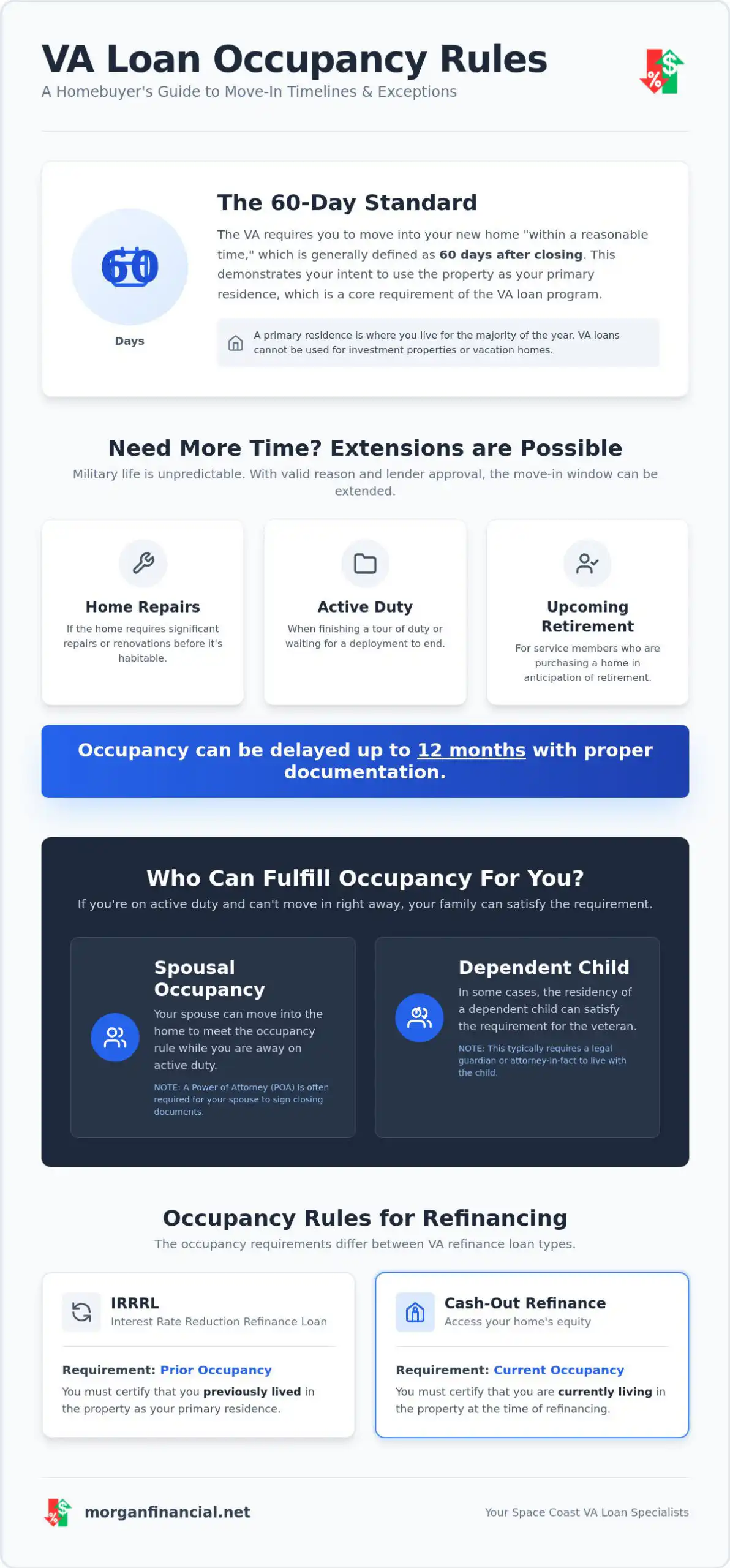
How soon do veterans have to move into a VA-financed home?
A VA borrower should plan to occupy the home within a reasonable period of time and should document any delayed move-in before closing. VA Form 26-1820 states that the veteran certifies they occupy the property, intend to move in and occupy it within a reasonable period, or intend to reoccupy after major repairs, alterations, or improvements.
The phrase “reasonable period” matters. It does not mean a buyer can close with no real plan to live in the property. It also does not mean every delayed move-in will be acceptable.
Common reasons a move-in plan may need extra review include:
| Situation | Occupancy concern | What to discuss before closing |
|---|---|---|
| PCS orders to Florida | Move-in date depends on report date or command timing | Orders, expected arrival date, and family move plan |
| Lease ending after closing | Buyer may not move immediately | Lease end date and realistic occupancy timeline |
| Home needs repairs | Property may not be livable right away | Repair scope, completion timeline, and reoccupancy plan |
| Veteran retiring soon | Move depends on separation or retirement date | Retirement documentation and Florida relocation plan |
| Spouse moving first | Veteran may be away on active duty | Spouse occupancy certification and active-duty status |
| Buying a 2–4 unit property | Buyer may rent other units | Which unit the veteran will occupy as home |
| Prior VA home retained | Buyer may own another VA-financed home | Entitlement, occupancy history, and new primary residence plan |
Morgan Financial’s VA Loan Command Center can help veterans review the occupancy story before the contract creates a problem.
Can a spouse or dependent child satisfy the VA occupancy rule?
Yes, in certain active-duty situations, a spouse or dependent child may help satisfy VA occupancy requirements when the veteran is unable to occupy because of military service. VA regulations state that for purchase or construction of residential property, the veteran or the spouse of an active-duty veteran who cannot occupy because of active duty must certify intent to occupy the property as a home.
VA Form 26-1820 also includes certifications for active-duty situations. One certification says that if the spouse is on active military duty, the signing spouse occupies or intends to occupy the property as a home; another addresses a dependent child occupying or intending to occupy the property when the veteran is on active duty.
This is important for Florida military families. A service member stationed elsewhere may have a spouse and children relocating to Brevard County first, especially around Patrick Space Force Base, Cape Canaveral, and the Melbourne area. The file should clearly show who will occupy the home and why the veteran cannot personally move in right away.
Can I use a VA loan for a rental property, second home, or PCS move?
A VA loan can work for a PCS move or a multi-unit home if the veteran will occupy the property as a primary residence, but it is not meant for buying a pure rental, vacation home, or second home. VA’s borrower-facing rule is clear: the borrower must live in the home bought with the loan.
That does not mean rental income is always impossible. VA allows purchase loans for homes with up to 4 units, which means a veteran may be able to live in one unit and rent the others if the full file meets VA and lender requirements.
A PCS move is different from buying an investment property. If the veteran is relocating to Florida and intends to make the new home the primary residence, the occupancy story may make sense. That is often how veterans end up holding two VA loans at the same time. If the veteran plans to stay elsewhere and rent the Florida home from day one, the file may not meet VA occupancy rules.
What property types can meet VA occupancy requirements?
VA occupancy can apply to several property types, but the veteran must still intend to live in the property as a home. VA says purchase loans may be used to buy a single-family home, a home with up to 4 units, a condo in a VA-approved project, a manufactured home or lot, a home with improvements, new construction, or energy-efficiency improvements.
Property type can affect how the occupancy plan is reviewed. A detached home in Palm Bay may be simple. A condo in Cocoa Beach, a duplex in Melbourne, or a property needing major repairs may require more documentation.
For a 2–4 unit property, the veteran should identify which unit they will occupy. For a condo, the project must be acceptable to VA. For a home with repairs, the timing of completion and occupancy should be discussed before closing.
What steps should Florida veterans take before closing?
Florida veterans should confirm their move-in plan, document any delay, review property eligibility, and avoid signing a contract that conflicts with VA occupancy rules. VA occupancy is not just a closing form; it is part of the loan’s eligibility and underwriting story.
Use this process before making an offer:
- Confirm the home will be your primary residence. Do not use VA financing for a property you already know will be a vacation home or pure rental.
- Explain your move-in timeline. Share PCS orders, retirement plans, lease timing, repair timing, or spouse relocation plans early.
- Check the property type. Condos, 2–4 unit homes, manufactured homes, and homes needing work can need extra review.
- Review entitlement if you still own another VA-financed home. VA says entitlement may be restored in some situations, and remaining entitlement may exist if full restoration is not available.
- Keep the story consistent. Your contract, application, insurance, employment, and move-in plan should all support the same primary-residence intent.
- Ask before assuming an exception applies. Active duty, spouse occupancy, dependent child occupancy, and delayed occupancy should be reviewed before closing.
Morgan Financial is veteran-owned, veteran-operated, and veteran-focused. For Space Coast buyers, local VA guidance matters because military timelines, Florida insurance, property type, and occupancy documentation can all affect the loan file.
FAQ: VA Loan Occupancy Requirements
Do I have to live in the home if I use a VA loan?
Yes. VA purchase loan rules require the borrower to live in the home being purchased. The home must be intended as a primary residence, not a vacation home or pure investment property. VA and the lender will review credit, income, occupancy, and the full loan file before approval.
How fast do I have to move in after closing?
It depends. VA Form 26-1820 uses the phrase “within a reasonable period of time,” so your move-in plan should be realistic and documented. Delays may need explanation if they involve PCS orders, repairs, lease timing, school schedules, or retirement dates.
Can my spouse move in before I do?
Yes, in certain active-duty situations. VA regulations allow a spouse of an active-duty veteran who cannot occupy because of military service to certify intent to occupy the property as a home. This should be reviewed before closing so the documentation matches the loan file.
Can I buy a duplex, triplex, or fourplex with a VA loan?
Yes, VA says a purchase loan may be used to buy a home with up to 4 units. The key is that the veteran must occupy the property as a home. Renting other units may be possible, but the file must still meet VA and lender requirements.
Can I use a VA loan for a second home in Florida?
No, not if it is truly a second home or vacation property. VA purchase loans require the borrower to live in the home being purchased. A Florida PCS or retirement move may work if the property will become the primary residence and the file supports that plan.
Can I move out later and rent the home?
Usually, a later move may be possible if your original occupancy intent was honest and your life circumstances changed. The key issue is your intent at application and closing. Do not close on a VA loan while secretly planning to rent the home immediately.
Can I use a VA loan if I am stationed outside Florida?
It depends. Active-duty service members may have occupancy options involving a spouse or dependent child, depending on the facts. A veteran stationed outside Florida should discuss orders, family relocation, and move-in timing with a VA-knowledgeable lender before making an offer.
Does VA occupancy guarantee loan approval?
No. Meeting occupancy rules does not guarantee approval. VA says borrowers must also qualify for a Certificate of Eligibility and meet VA and lender standards for credit, income, and other requirements. Final approval depends on the full file and underwriting review.
Conclusion
VA loan occupancy requirements are simple in concept: the home must be intended as your primary residence, but military life can make the timing more detailed. PCS orders, spouse occupancy, dependent child occupancy, repairs, and retained homes should be reviewed before closing.
Morgan Financial helps veterans and active-duty buyers in Florida understand VA loan rules before they make an offer. Contact Morgan Financial or start with the VA Loan Command Center for local, veteran-focused guidance.
Compliance Disclaimer
Mortgage guidelines, rates, fees, and program requirements can change and may vary based on credit, income, assets, property type, occupancy, loan amount, and underwriting findings. This article is for educational purposes only and is not a commitment to lend or a guarantee of approval. Contact Morgan Financial for guidance specific to your situation.
Disclaimer
This content is provided for informational purposes only and should not be construed as financial, legal, or lending advice. It is not a commitment to lend. Mortgage programs, rates, terms, and availability are subject to change without notice and may vary by borrower and location. All loans are subject to credit approval and applicable underwriting guidelines. Not all applicants will qualify. Consult with a licensed mortgage professional regarding your specific situation.